Green AI: How Efficient Models Are Reducing the Carbon Footprint of Machine Learning

A quiet revolution is underway in artificial intelligence research, one that challenges the prevailing assumption that bigger is always better. While headlines celebrate models with hundreds of billions of parameters, a growing cohort of researchers is demonstrating that carefully designed smaller models can match or exceed the performance of their larger counterparts while consuming a fraction of the energy.
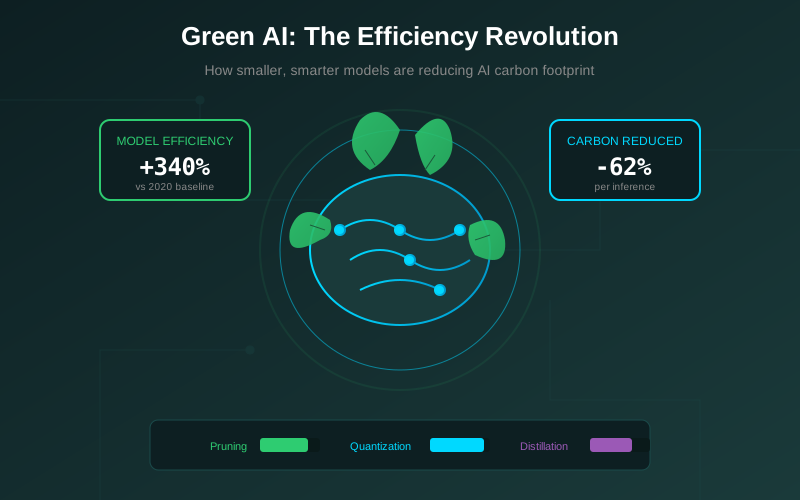
The techniques driving this efficiency revolution are elegantly simple in concept, though demanding in execution. Model pruning removes redundant connections from neural networks, like trimming unnecessary branches from a tree without affecting its fruit. A well-pruned model can retain 90% of its original accuracy while requiring only a third of the computational resources. The biological brain, it turns out, operates on similar principles—synaptic pruning during childhood eliminates weak neural connections to improve cognitive efficiency.
Quantization takes a different approach, reducing the numerical precision used to represent model weights. Where traditional models might use 32-bit floating-point numbers, quantized models operate with 8-bit or even 4-bit representations. This seemingly small change cascades through the entire computational pipeline, reducing memory bandwidth, accelerating calculations, and dramatically cutting energy consumption. Recent advances in quantization-aware training have minimized the accuracy penalties that once accompanied these optimizations.
Knowledge distillation offers perhaps the most intuitive path to efficiency. A large, computationally expensive model serves as a teacher, training a smaller student model to replicate its behavior. The student learns not just from the correct answers but from the nuanced probability distributions the teacher produces—a richer learning signal that enables smaller models to punch above their weight class. Distilled models now power many consumer-facing AI features, delivering sophisticated capabilities on mobile devices that would otherwise require cloud connectivity.
These techniques are not merely academic exercises. Major technology companies report that efficiency improvements have allowed them to serve the same AI workloads with 40-60% less energy than just two years ago. The economic incentives align perfectly with environmental benefits—lower energy consumption means lower operating costs and the ability to deploy AI capabilities in resource-constrained environments.
The cultural shift toward efficiency-aware AI development may prove as important as the technical innovations themselves. When researchers and practitioners consider carbon footprint alongside accuracy metrics, when deployment decisions factor in the environmental cost of each inference, the field moves toward genuine sustainability. The most powerful AI is not necessarily the largest—it is the one that delivers the greatest value with the least environmental impact.