Author: admin_greentech

  • Smart Grids and AI: Optimizing Renewable Energy for Maximum Impact

    Smart Grids and AI: Optimizing Renewable Energy for Maximum Impact

    AI Renewable Energy

    The transition to renewable energy faces a fundamental challenge that has little to do with technology and everything to do with timing. Solar panels generate electricity when the sun shines, wind turbines spin when the wind blows, but demand for electricity follows its own rhythms—peaks in the morning as people wake, valleys in the dead of night, surges during heat waves when air conditioners run full blast. Bridging this gap between variable supply and fluctuating demand is where artificial intelligence is proving transformative.

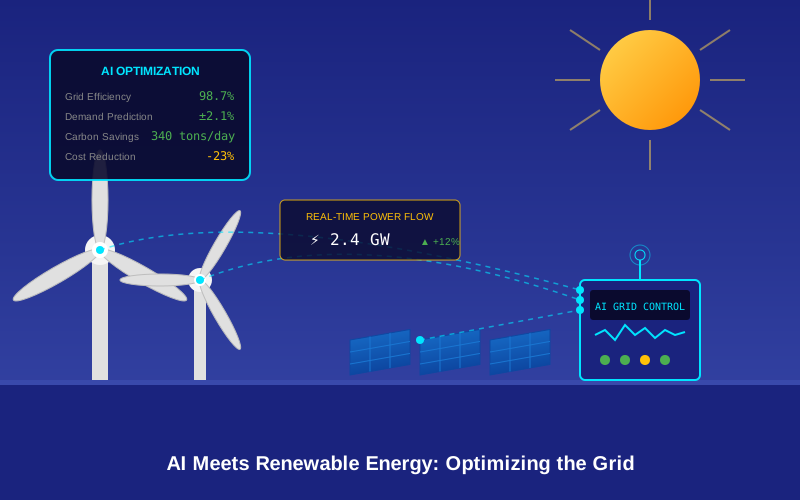
    Machine learning algorithms can now predict solar and wind generation with remarkable accuracy, incorporating weather forecasts, historical patterns, and real-time sensor data to anticipate output hours or even days in advance. These predictions enable grid operators to plan accordingly, ramping up backup generation or activating demand response programs before shortfalls occur rather than scrambling to react after the fact. The result is a more stable grid that can accommodate higher percentages of renewable generation without sacrificing reliability.

    Demand prediction has evolved with similar sophistication. AI systems analyze patterns in energy consumption across millions of customers, identifying not just aggregate trends but individual behaviors that influence grid load. Smart thermostats and connected appliances can be orchestrated to shift consumption to times of abundant renewable generation, reducing peak demand and minimizing the need for fossil fuel peaker plants. This coordination happens invisibly, without requiring conscious effort from consumers.

    Battery storage represents another frontier where AI is making renewable energy more viable. Machine learning optimizes when to charge and discharge grid-scale batteries, maximizing the economic and environmental value of stored energy. Algorithms must balance multiple objectives: smoothing renewable intermittency, providing frequency regulation, and responding to market price signals. The complexity of this optimization problem is precisely suited to AI capabilities, and the results are impressive—AI-managed storage systems can extract significantly more value from the same hardware than rule-based approaches.

    The distributed nature of modern energy systems presents both challenges and opportunities for AI optimization. Rooftop solar, home batteries, electric vehicles, and smart appliances create a complex web of energy producers and consumers. AI can orchestrate these distributed resources as virtual power plants, aggregating their collective capacity to provide grid services that once required large central facilities. A neighborhood of homes with solar panels and batteries, coordinated by intelligent algorithms, can contribute to grid stability in ways that benefit everyone.

    The partnership between AI and renewable energy creates a virtuous cycle. More accurate predictions enable higher renewable penetration, which generates more data to improve predictions further. Each increment of intelligence in the grid unlocks additional potential for clean energy integration. The fully optimized grid of the future—responsive, resilient, and running primarily on renewable sources—is not a distant dream but an emerging reality, built one algorithm at a time.

  • Sustainable AI Hardware: Building Chips for a Circular Economy

    Sustainable AI Hardware: Building Chips for a Circular Economy

    Sustainable AI Hardware

    The processors powering artificial intelligence represent some of the most sophisticated manufactured objects in human history. These chips contain billions of transistors etched at scales measured in nanometers, requiring extraordinarily pure materials and energy-intensive fabrication processes. As AI demand accelerates, the semiconductor industry faces a critical question: can we build the computational infrastructure of the future without depleting the resources of the present?

    The environmental footprint of chip manufacturing extends far beyond the finished product. Producing a single advanced processor requires thousands of gallons of ultrapure water, significant quantities of rare earth elements, and manufacturing processes that release potent greenhouse gases. The factories themselves—multi-billion dollar facilities called fabs—consume as much electricity as small cities. Traditional approaches to chip design have prioritized performance above all else, treating environmental impact as an externality to be managed rather than a design constraint to be optimized.

    This calculus is beginning to shift. Leading semiconductor manufacturers are redesigning their processes to reduce water consumption, capture and neutralize harmful emissions, and transition to renewable energy sources. TSMC, the worlds largest contract chipmaker, has committed to net-zero emissions by 2050 and is already running some facilities on 100% renewable electricity. Intel is developing novel materials that could eliminate the need for certain rare earth elements entirely.

    The architecture of AI chips themselves is evolving toward sustainability. New designs optimize for performance per watt rather than raw speed, recognizing that energy efficiency and environmental responsibility are increasingly synonymous with competitive advantage. Specialized AI accelerators can perform machine learning tasks with ten to one hundred times less energy than general-purpose processors, enabling the same capabilities with a fraction of the environmental impact.

    The challenge of e-waste looms large in any discussion of sustainable hardware. The rapid pace of AI advancement has created a troubling dynamic where cutting-edge chips become obsolete within years, destined for landfills where their toxic materials can leach into soil and groundwater. Forward-thinking manufacturers are responding with modular designs that allow components to be upgraded rather than replaced entirely, and with take-back programs that ensure proper recycling of retired hardware.

    The vision of a circular economy for AI hardware—where materials flow in closed loops from manufacturing through use to recycling and back again—remains aspirational but increasingly achievable. Researchers are developing techniques to recover and refine materials from retired chips at industrial scale. New substrate materials derived from renewable sources could replace petroleum-based components. The chip of the future might be not only more powerful than todays designs but also more sustainable from cradle to cradle.

  • AI-Powered Climate Modeling: Predicting Tomorrow to Protect Our Future

    AI-Powered Climate Modeling: Predicting Tomorrow to Protect Our Future

    AI Climate Modeling

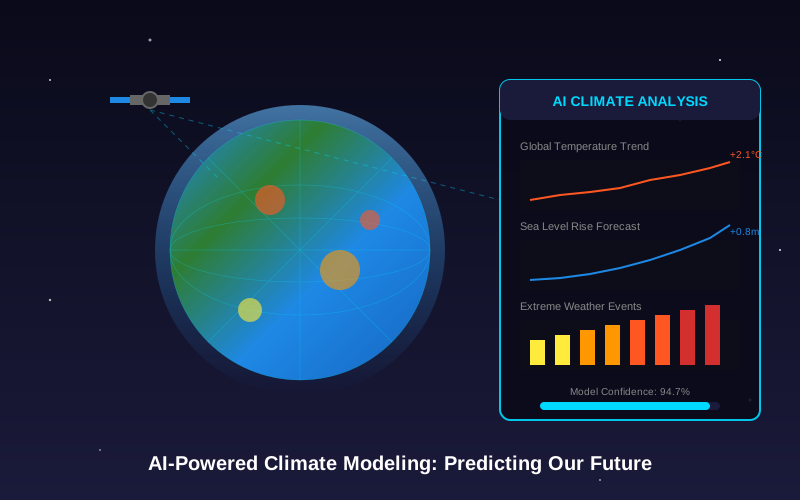
    Climate science has always been a discipline of immense complexity, attempting to model the intricate dance of atmospheric physics, ocean currents, ice dynamics, and countless feedback loops that determine our planetary future. Traditional climate models, while remarkably sophisticated, have been constrained by computational limitations that forced researchers to make simplifying assumptions. Artificial intelligence is now changing that equation, enabling climate predictions of unprecedented detail and accuracy.

    Machine learning excels at finding patterns in data that would overwhelm human analysts. When trained on decades of satellite imagery, weather station records, and oceanographic measurements, AI systems can identify subtle correlations that inform more accurate predictions. Neural networks have learned to recognize the fingerprints of El Niño events months before traditional methods detect them, providing crucial advance warning for agriculture, disaster preparedness, and resource management.

    The resolution of climate predictions has improved dramatically with AI assistance. Where traditional models might divide the Earth into grid cells 100 kilometers across, AI-enhanced models can resolve features at scales of just a few kilometers. This granularity transforms climate information from abstract regional trends into actionable local forecasts. A farmer in Gujarat can now access predictions tailored to her specific fields rather than broad regional averages.

    Extreme weather prediction has become a particular strength of AI-powered systems. By learning from historical data on hurricanes, heat waves, and flooding events, machine learning models can identify the conditions that precede disasters with increasing reliability. Google DeepMind recent work on medium-range weather forecasting matched the accuracy of the European Centre for Medium-Range Weather Forecasts while requiring a fraction of the computational resources—a development that could democratize access to high-quality weather prediction worldwide.

    The irony of using energy-intensive AI to address climate change is not lost on researchers. The field has responded by developing climate-specific AI architectures optimized for efficiency. Physics-informed neural networks incorporate known physical laws directly into their structure, reducing the amount of data and computation required to achieve accurate predictions. These hybrid approaches combine the strengths of traditional climate science with the pattern-recognition capabilities of machine learning.

    Perhaps most importantly, AI is accelerating the communication of climate science to policymakers and the public. Complex model outputs can be translated into clear visualizations and scenario analyses that support informed decision-making. When communities can see precisely how different emissions pathways might affect their specific region, abstract global targets become concrete local imperatives. In this way, AI serves not just as a scientific tool but as a bridge between research and action.

  • Green AI: How Efficient Models Are Reducing the Carbon Footprint of Machine Learning

    Green AI: How Efficient Models Are Reducing the Carbon Footprint of Machine Learning

    Green AI Efficiency

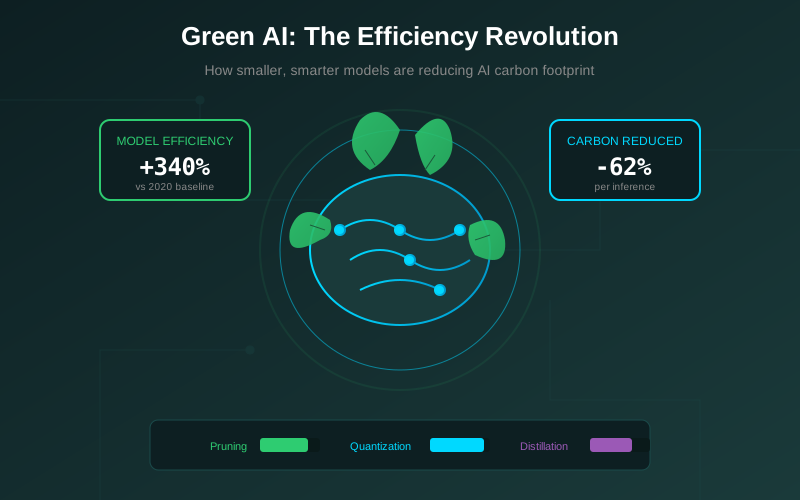
    A quiet revolution is underway in artificial intelligence research, one that challenges the prevailing assumption that bigger is always better. While headlines celebrate models with hundreds of billions of parameters, a growing cohort of researchers is demonstrating that carefully designed smaller models can match or exceed the performance of their larger counterparts while consuming a fraction of the energy.

    The techniques driving this efficiency revolution are elegantly simple in concept, though demanding in execution. Model pruning removes redundant connections from neural networks, like trimming unnecessary branches from a tree without affecting its fruit. A well-pruned model can retain 90% of its original accuracy while requiring only a third of the computational resources. The biological brain, it turns out, operates on similar principles—synaptic pruning during childhood eliminates weak neural connections to improve cognitive efficiency.

    Quantization takes a different approach, reducing the numerical precision used to represent model weights. Where traditional models might use 32-bit floating-point numbers, quantized models operate with 8-bit or even 4-bit representations. This seemingly small change cascades through the entire computational pipeline, reducing memory bandwidth, accelerating calculations, and dramatically cutting energy consumption. Recent advances in quantization-aware training have minimized the accuracy penalties that once accompanied these optimizations.

    Knowledge distillation offers perhaps the most intuitive path to efficiency. A large, computationally expensive model serves as a teacher, training a smaller student model to replicate its behavior. The student learns not just from the correct answers but from the nuanced probability distributions the teacher produces—a richer learning signal that enables smaller models to punch above their weight class. Distilled models now power many consumer-facing AI features, delivering sophisticated capabilities on mobile devices that would otherwise require cloud connectivity.

    These techniques are not merely academic exercises. Major technology companies report that efficiency improvements have allowed them to serve the same AI workloads with 40-60% less energy than just two years ago. The economic incentives align perfectly with environmental benefits—lower energy consumption means lower operating costs and the ability to deploy AI capabilities in resource-constrained environments.

    The cultural shift toward efficiency-aware AI development may prove as important as the technical innovations themselves. When researchers and practitioners consider carbon footprint alongside accuracy metrics, when deployment decisions factor in the environmental cost of each inference, the field moves toward genuine sustainability. The most powerful AI is not necessarily the largest—it is the one that delivers the greatest value with the least environmental impact.

  • The Hidden Carbon Cost of AI: Understanding Data Center Energy Consumption

    The Hidden Carbon Cost of AI: Understanding Data Center Energy Consumption

    AI Data Center Energy Visualization

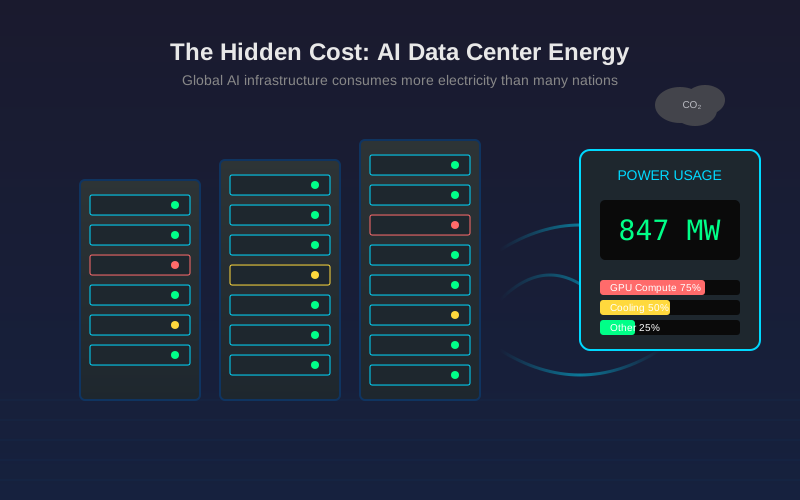
    The artificial intelligence revolution has brought unprecedented capabilities to industries worldwide, from healthcare diagnostics to climate research. Yet beneath the sleek interfaces and remarkable outputs lies an uncomfortable truth: the environmental footprint of AI is growing at an alarming rate, driven primarily by the massive energy demands of data centers that power these systems.

    Training a single large language model can consume as much electricity as five average American homes use in an entire year. When researchers at the University of Massachusetts Amherst calculated the carbon footprint of training common AI models, they found that the process could emit more than 626,000 pounds of carbon dioxide—roughly equivalent to the lifetime emissions of five automobiles. These figures have only increased as models have grown larger and more sophisticated.

    The challenge extends beyond training. Every query to an AI system, every image generated, every recommendation served requires computational power. Global data centers already consume approximately 1-2% of worldwide electricity, and AI workloads represent the fastest-growing segment of this demand. Industry analysts project that AI-related energy consumption could increase tenfold by 2030 if current trends continue unchecked.

    Major technology companies have recognized this challenge and are responding with varying degrees of urgency. Google has committed to operating on carbon-free energy around the clock by 2030. Microsoft has pledged to become carbon negative by the same year. Amazon Web Services is pursuing 100% renewable energy for its operations. These commitments represent genuine progress, but the rapid expansion of AI capabilities continues to outpace efficiency gains.

    The path forward requires a multi-faceted approach. Hardware manufacturers are developing specialized AI chips that deliver more computations per watt. Researchers are creating more efficient model architectures that require less training data and computational resources. Data center operators are innovating with liquid cooling systems, waste heat recovery, and strategic placement in cooler climates or near renewable energy sources.

    Perhaps most importantly, the AI community is beginning to treat energy efficiency as a first-class metric alongside accuracy and speed. Conferences now require researchers to report the computational costs of their experiments. New benchmarks measure performance per watt rather than raw capability. This cultural shift, while nascent, signals a maturing field that recognizes its environmental responsibilities.

    The question is not whether AI will continue to advance—it surely will. The question is whether we can guide that advancement in ways that align with planetary boundaries. The technology that helps us model climate change must not become a significant contributor to it. Finding this balance represents one of the defining challenges of our technological age.

Preview Themes

See how this site looks in different styles

Aurora

Elegant & Minimalist

Meridian

Bold & Contemporary

Twenty Twenty-Five

WordPress Default