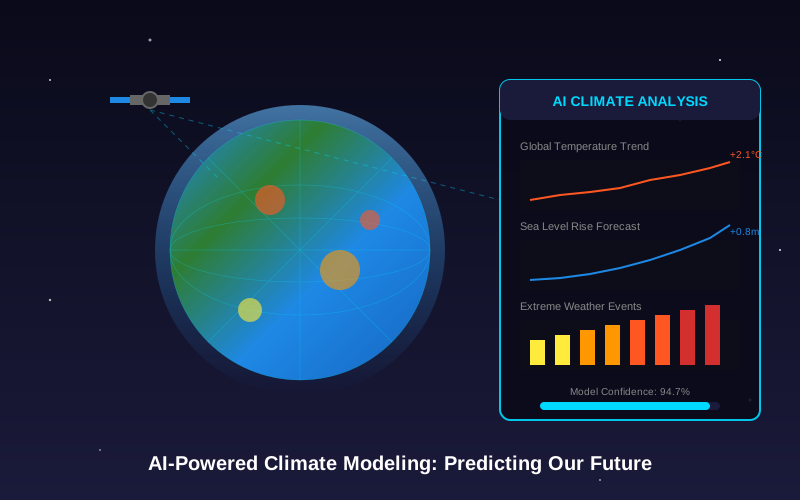
Climate science has always been a discipline of immense complexity, attempting to model the intricate dance of atmospheric physics, ocean currents, ice dynamics, and countless feedback loops that determine our planetary future. Traditional climate models, while remarkably sophisticated, have been constrained by computational limitations that forced researchers to make simplifying assumptions. Artificial intelligence is now changing that equation, enabling climate predictions of unprecedented detail and accuracy.
Machine learning excels at finding patterns in data that would overwhelm human analysts. When trained on decades of satellite imagery, weather station records, and oceanographic measurements, AI systems can identify subtle correlations that inform more accurate predictions. Neural networks have learned to recognize the fingerprints of El Niño events months before traditional methods detect them, providing crucial advance warning for agriculture, disaster preparedness, and resource management.
The resolution of climate predictions has improved dramatically with AI assistance. Where traditional models might divide the Earth into grid cells 100 kilometers across, AI-enhanced models can resolve features at scales of just a few kilometers. This granularity transforms climate information from abstract regional trends into actionable local forecasts. A farmer in Gujarat can now access predictions tailored to her specific fields rather than broad regional averages.
Extreme weather prediction has become a particular strength of AI-powered systems. By learning from historical data on hurricanes, heat waves, and flooding events, machine learning models can identify the conditions that precede disasters with increasing reliability. Google DeepMind recent work on medium-range weather forecasting matched the accuracy of the European Centre for Medium-Range Weather Forecasts while requiring a fraction of the computational resources—a development that could democratize access to high-quality weather prediction worldwide.
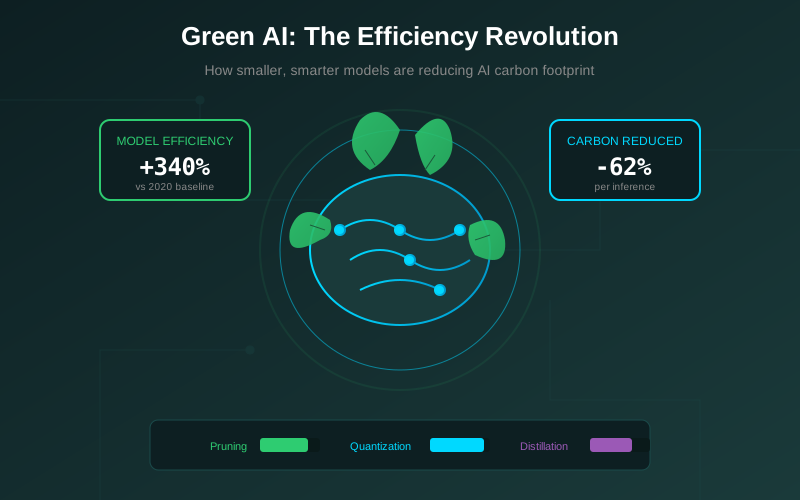
The irony of using energy-intensive AI to address climate change is not lost on researchers. The field has responded by developing climate-specific AI architectures optimized for efficiency. Physics-informed neural networks incorporate known physical laws directly into their structure, reducing the amount of data and computation required to achieve accurate predictions. These hybrid approaches combine the strengths of traditional climate science with the pattern-recognition capabilities of machine learning.
Perhaps most importantly, AI is accelerating the communication of climate science to policymakers and the public. Complex model outputs can be translated into clear visualizations and scenario analyses that support informed decision-making. When communities can see precisely how different emissions pathways might affect their specific region, abstract global targets become concrete local imperatives. In this way, AI serves not just as a scientific tool but as a bridge between research and action.