The Hidden Carbon Cost of AI: Understanding Data Center Energy Consumption

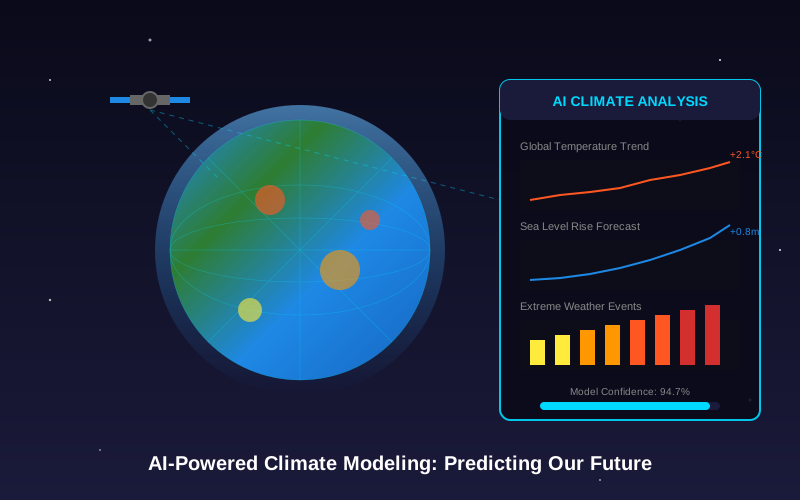
The artificial intelligence revolution has brought unprecedented capabilities to industries worldwide, from healthcare diagnostics to climate research. Yet beneath the sleek interfaces and remarkable outputs lies an uncomfortable truth: the environmental footprint of AI is growing at an alarming rate, driven primarily by the massive energy demands of data centers that power these systems.
Training a single large language model can consume as much electricity as five average American homes use in an entire year. When researchers at the University of Massachusetts Amherst calculated the carbon footprint of training common AI models, they found that the process could emit more than 626,000 pounds of carbon dioxide—roughly equivalent to the lifetime emissions of five automobiles. These figures have only increased as models have grown larger and more sophisticated.
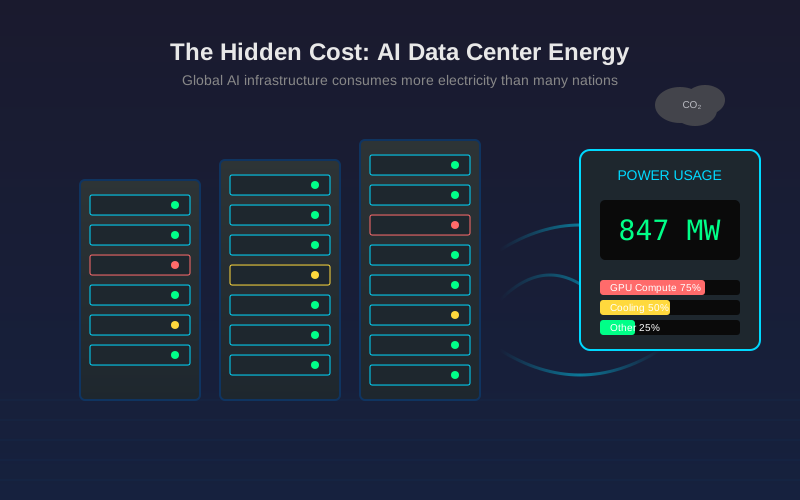
The challenge extends beyond training. Every query to an AI system, every image generated, every recommendation served requires computational power. Global data centers already consume approximately 1-2% of worldwide electricity, and AI workloads represent the fastest-growing segment of this demand. Industry analysts project that AI-related energy consumption could increase tenfold by 2030 if current trends continue unchecked.
Major technology companies have recognized this challenge and are responding with varying degrees of urgency. Google has committed to operating on carbon-free energy around the clock by 2030. Microsoft has pledged to become carbon negative by the same year. Amazon Web Services is pursuing 100% renewable energy for its operations. These commitments represent genuine progress, but the rapid expansion of AI capabilities continues to outpace efficiency gains.
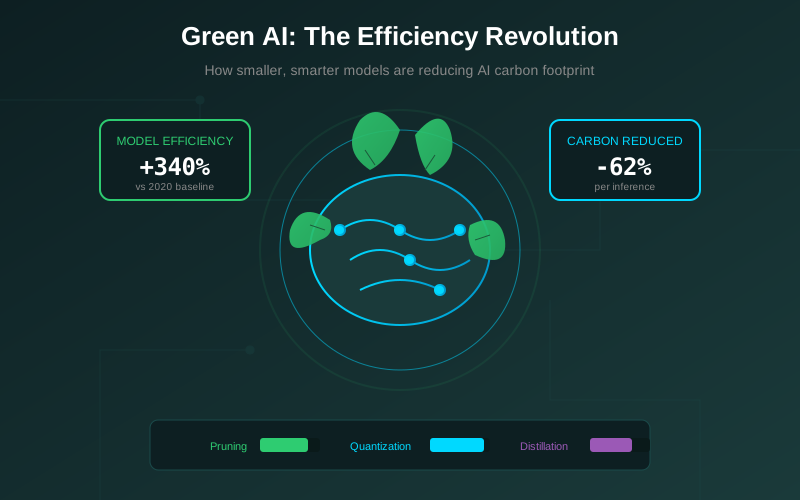
The path forward requires a multi-faceted approach. Hardware manufacturers are developing specialized AI chips that deliver more computations per watt. Researchers are creating more efficient model architectures that require less training data and computational resources. Data center operators are innovating with liquid cooling systems, waste heat recovery, and strategic placement in cooler climates or near renewable energy sources.
Perhaps most importantly, the AI community is beginning to treat energy efficiency as a first-class metric alongside accuracy and speed. Conferences now require researchers to report the computational costs of their experiments. New benchmarks measure performance per watt rather than raw capability. This cultural shift, while nascent, signals a maturing field that recognizes its environmental responsibilities.
The question is not whether AI will continue to advance—it surely will. The question is whether we can guide that advancement in ways that align with planetary boundaries. The technology that helps us model climate change must not become a significant contributor to it. Finding this balance represents one of the defining challenges of our technological age.